

Saint Augustine Beach Property Management: Why It Matters


Saint Augustine Beach property management is the professional oversight of a short-term rental, covering pricing, guest communication, cleaning, maintenance, and compliance, so an owner doesn't have to handle it alone. In The Sun VR works with owners across St. Augustine, FL who want hospitality-driven management instead of a hands-off, transactional relationship with their property.
Key Takeaways
St. Augustine had 7,068 active short-term rental listings as of June 2026, generating an average of $34,500 per listing annually, according to AirDNA's 2026 market report.
Trailing-year data through June 2026 shows a 55% average occupancy rate and $289 average daily rate, producing $158 RevPAR across St. Augustine STRs.
Professional STR managers typically charge 15-25% of gross rental revenue, often with an additional 1-5% for cleaning and ancillary services.
St. Augustine's STR supply grew more than 40% year-over-year per AirROI's 2026 data, meaning owners now compete against more listings for the same guest pool.
Peak-season months like March, June, and July average roughly 59.5% occupancy and $323 daily rate, while low-season months (January, September, October) drop to about 36.1% occupancy.
Choosing a management company involves comparing services, pricing transparency, technology and reporting, review reputation, and local regulatory knowledge specific to St. Johns County.
If you own a rental property near the shoreline in St. Augustine, you already know the drill: guest messages at odd hours, a cleaner who cancels the morning of a turnover, and a nagging suspicion your calendar has more empty nights than it should. That's the exact gap professional Saint Augustine Beach property management is built to close.
This guide breaks down what property management actually includes in this market, what it costs, how it affects occupancy and revenue, and what regulatory issues owners in St. Johns County need to understand before listing a property. We'll also walk through how to evaluate a management company using the same criteria experienced investors use, not just star ratings.
In 2026, the St. Augustine short-term rental market looks different than it did even two years ago. Supply has surged, average daily rates have climbed, and the properties winning the booking calendar are the ones with sharper pricing strategy and better guest experience, not just a nice view. That shift is exactly why management quality matters more now than it did when the market had fewer listings competing for attention.
What Does Property Management Actually Include in St. Augustine?
Saint Augustine Beach property management refers to the full operational handling of a short-term rental on an owner's behalf, including pricing strategy, guest communication, cleaning coordination, maintenance response, and regulatory compliance. It is not just answering messages, it's running a small hospitality business.
Specifically, a full-service management arrangement typically covers listing optimization on platforms like Airbnb and VRBO, dynamic pricing adjustments based on demand data, coordinating turnover cleaning between checkout and check-in, fielding guest inquiries and issues around the clock, and handling St. Johns County tax remittance and permit renewals. As a result, owners are freed from the daily operational load that turns a passive investment into an unpaid second job.
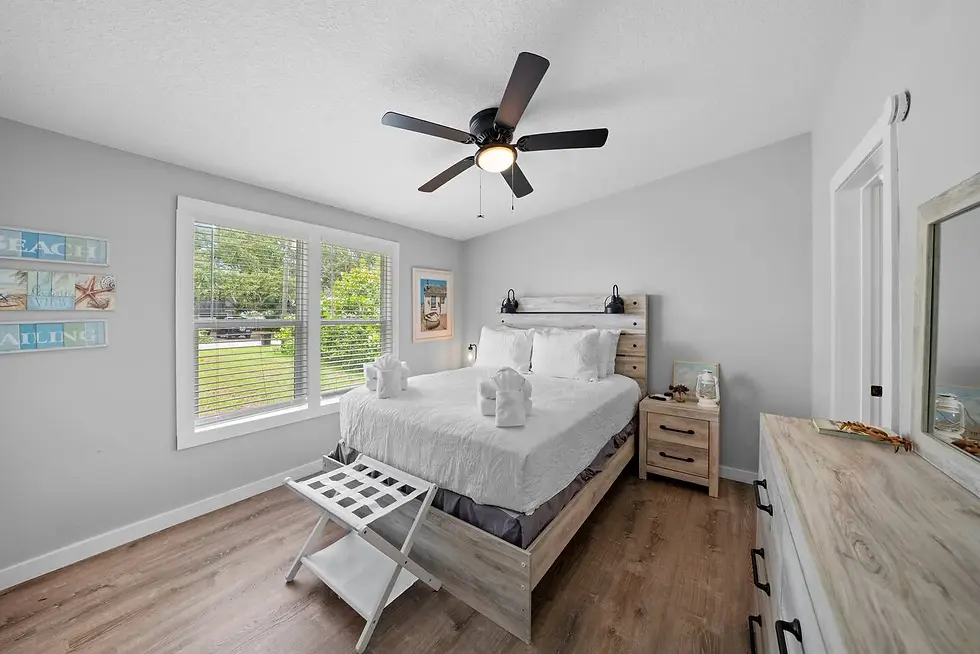
At In The Sun VR, we treat every managed property, whether it's a Vilano Beach cottage or a multi-bedroom historic home downtown, like a hospitality product, not just a listing. That means the interior design, the pricing calendar, and the guest response time all get the same attention a boutique hotel would give them. Owners who switch from self-managing to full management often tell us the biggest surprise isn't the extra bookings, it's getting their evenings and weekends back.
Not every owner needs the same level of service, though. Some want full hands-off management, while others prefer co-hosting arrangements that keep them partially involved. The right fit depends on how much time, capital, and risk tolerance the owner brings to the table.
Why Does Property Management Matter for Occupancy and Revenue?
Property management matters because pricing and guest experience directly determine occupancy and daily rate, and self-managed owners frequently leave revenue on the table by guessing at rates instead of tracking demand. St. Augustine's own market data makes this concrete: trailing-year figures through June 2026 show a 55% average occupancy rate and $289 average daily rate, per AirDNA. That gap between peak and low season is significant. AirROI's seasonal breakdown shows peak months like March, June, and July averaging around 59.5% occupancy and $323 in daily rate, while low-season months such as January, September, and October fall to roughly 36.1% occupancy and $308 daily rate. An owner using flat, static pricing year-round is guaranteed to underperform in one direction or the other.
Additionally, AirROI reported that active St. Augustine listings grew 40.2% year-over-year as of May 2026, reaching 1,699 active listings in that dataset with average annual revenue of $41,902 per listing. More competition means a mediocre listing photo set or a slow guest response time costs real bookings, not just minor inconvenience.
We've seen this play out firsthand: properties that adjust pricing weekly instead of seasonally consistently outperform neighbors with similar bedroom counts and amenities. The difference isn't luck, it's attention. That's the core argument for revenue management as a standalone service, not an afterthought bundled into a generic package.
How Much Does Vacation Rental Management Cost in St. Augustine?
Short-term rental management companies typically charge 15-25% of gross rental revenue as a base management fee, with many adding an extra 1-5% of gross revenue for cleaning coordination and ancillary services. On a property earning the St. Augustine average of roughly $34,500 to $43,550 annually (per AirDNA and Chalet data respectively), that translates to a management cost somewhere between $5,000 and $11,000 per year, depending on the fee structure and service scope. Some companies charge flat monthly fees instead, while others bundle pricing optimization, guest communication, and turnover coordination into a single percentage. Full-service models tend to cost more upfront but reduce the owner's time investment to near zero. Co-hosting arrangements, by contrast, often run lower percentages because the owner retains more responsibility. The right comparison isn't the sticker price, it's net revenue after fees. A management company charging 20% but consistently hitting 60%+ occupancy through dynamic pricing may net an owner more than a 12%-fee company that lets the calendar sit empty in shoulder season.
Management Model | Typical Fee Range | Owner Time Commitment | Best Fit For |
Self-Management | 0% (but unpaid labor) | High, daily involvement | Local owners with flexible schedules |
Co-Hosting | Roughly 10-15% of revenue | Moderate, owner stays involved | Owners who want partial control |
Full-Service Management | 15-25% of revenue, plus cleaning fees | Low, mostly oversight | Absentee owners, portfolio investors |
What Regulatory Rules Apply to Short-Term Rentals Near St. Augustine Beach?
Short-term rental regulation in St. Augustine involves overlapping requirements from St. Johns County and, depending on the property's location, the City of St. Augustine or the City of St. Augustine Beach, covering business tax receipts, occupancy limits, and tourist development tax collection. Owners who skip this step risk fines or a shutdown notice mid-season. Specifically, most STR owners need a local business tax receipt, must remit Florida's state sales tax and the county's tourist development tax, and may face parking or occupancy restrictions tied to their zoning designation. Requirements have shifted in recent years as county officials respond to the rapid growth in listings, so a rule that applied in 2026 may not reflect the current 2026 ordinance. This is one of the areas we see trip up first-time hosts most often. Regulatory tracking isn't a one-time task, it's ongoing, because permit renewal deadlines and tax remittance schedules don't pause for a busy booking season. Owners should confirm current requirements directly with St. Johns County and municipal offices rather than relying on outdated blog posts or hearsay from a neighbor. A management partner who tracks these changes as part of their service removes this risk entirely instead of leaving the owner to monitor county meeting minutes.
How Do You Choose the Right Property Management Company in St. Augustine?
Choosing a property management company means comparing five factors: services offered, pricing transparency, technology and reporting quality, review reputation, and local market expertise specific to St. Augustine's neighborhoods. Skipping any one of these usually shows up later as a bad surprise. First, confirm exactly what's included in the fee, some companies bundle photography and listing optimization, others charge extra. Second, ask how often you'll receive performance reports and what metrics they track, monthly reporting on occupancy, ADR, and RevPAR is the baseline, not a bonus feature. Third, read recent reviews specifically about responsiveness and payout accuracy, not just property photos. Local expertise matters more in a seasonal market like this one than owners often expect. A manager who understands that Vilano Beach draws a different guest profile than the downtown historic district, and prices accordingly, will consistently outperform a generic national platform applying the same playbook everywhere. Several companies serve the St. Augustine area, including Coastal Realty & Property Management, Ocean Realty & Property Management, and Casago, alongside boutique operators like In The Sun VR. Comparing a few directly, on the criteria above rather than marketing copy alone, is worth the hour it takes.
Common Mistakes Owners Make When Hiring a Manager
Choosing based on fee percentage alone instead of net revenue after fees and occupancy performance.
Not asking about reporting cadence until after signing, then discovering updates are quarterly instead of monthly.
Assuming all "full-service" packages are identical when scope varies widely between companies.
Ignoring interior design and staging as a revenue lever, a dated interior can suppress bookings even with perfect pricing.
Overlooking compliance responsibility, some management agreements don't include regulatory tracking at all.

What's the Real ROI of Professional Management Versus Self-Managing?
The real return on professional management comes from the combination of higher occupancy through active pricing, fewer negative reviews from missed guest communication, and time saved that owners can redirect elsewhere. It is rarely captured by a single number, but the underlying levers are measurable. For example, an owner self-managing with static, seasonal pricing is very likely leaving revenue on the table during both the high-demand spring months and the slower fall shoulder season, since neither extreme gets addressed without weekly adjustment. Professional operators who adjust rates based on real-time demand data, rather than a fixed calendar, consistently capture more of both the peaks and the troughs. Beyond pricing, guest communication speed affects conversion and reviews directly. A property that answers inquiries within minutes converts more lookers into bookers than one that responds the next day. Multiply that across dozens of monthly inquiries, and the compounding effect on occupancy becomes clear even without a single fabricated statistic to prove it. The properties we manage at In The Sun VR benefit from having one accountable team handling pricing, communication, and turnovers together, rather than an owner trying to coordinate cleaners, a pricing tool, and guest messages across three separate systems.
What Should Monthly Owner Reporting Actually Include?
Monthly owner reporting should include occupancy rate, average daily rate, RevPAR, gross revenue, itemized expenses, and a summary of any maintenance or guest issues from that period. Anything less leaves an owner unable to verify whether their manager is actually performing. Specifically, look for a report that breaks down revenue by booking source (direct site, Airbnb, VRBO), flags upcoming maintenance needs before they become emergencies, and compares current performance against the prior month or the same month last year. Transparency here is a strong signal of a management company's overall trustworthiness. A vague report, or one that shows up late every month, is often an early warning sign of bigger operational issues.
Data Snapshot: St. Augustine Short-Term Rental Market in 2026
The table below consolidates verified market data points from AirDNA, AirROI, StaySTRA, and Chalet to give owners a factual baseline for evaluating their own property's performance against the broader St. Augustine market as of 2026.
Metric | Figure | Source |
Active STR listings | 7,068 (June 2026) | AirDNA |
Average annual revenue per listing | $34,500 to $43,550 | AirDNA / Chalet |
Average occupancy rate (trailing year) | 55% | AirDNA |
Average daily rate (trailing year) | $289 | AirDNA |
RevPAR | $158 | AirDNA |
Year-over-year listing growth | 40.2% | AirROI |
Peak season occupancy (March, June, July) | ~59.5% | AirROI |
Low season occupancy (Jan, Sept, Oct) | ~36.1% | AirROI |
These figures underscore why static, one-time pricing decisions underperform in this market. A property earning below the $34,500 average benchmark is a signal to review pricing strategy, listing photos, and guest response times before assuming the market itself is soft.
Where Do Owners Get the Best Return: Vilano Beach, Downtown, or St. Augustine Beach?
Location shapes both guest demand and appropriate design choices, and it changes what a management strategy should prioritize. Vilano Beach properties, for instance, attract a beach-and-relaxation crowd looking for hot tubs, fire pits, and proximity to the shoreline. A property like Vilano Vista, sitting on a corner lot in the heart of Vilano Beach with a 7-seater hot tub and dual fire pits, is designed specifically around that guest profile. Downtown historic district properties draw a different traveler entirely, often couples or groups drawn to walkability and architecture. Victorian Villa, a restored 3-story Victorian just a 6-minute walk to St. George Street, illustrates how a historic property can be repositioned to command premium rates from group travelers rather than competing purely on beach proximity. Crescent Beach and Butler Beach properties, meanwhile, tend to draw guests focused on water activities. Point Break sits just 0.1 miles from Crescent Beach access via a pedestrian walk path, with kayaks and paddleboards on site, a location advantage that shapes both amenity choices and pricing strategy for that specific micro-market. Understanding these differences is part of why a one-size-fits-all national management platform often underperforms a locally rooted operator that prices and designs around neighborhood-specific demand.
Practical Guidance: How to Evaluate a Management Proposal Before Signing
Request the fee structure in writing, including whether cleaning, maintenance dispatch, and photography are included or billed separately.
Ask for a sample owner report from an existing managed property to see actual reporting depth, not a marketing mockup.
Confirm who handles regulatory compliance, including St. Johns County business tax receipts and tourist tax remittance.
Clarify the pricing strategy, ask whether rates adjust weekly or seasonally, and whether a human reviews the algorithm's suggestions.
Check response time commitments for guest communication, both during business hours and overnight.
Review the cancellation and contract terms before signing anything longer than a 12-month initial term.
For owners weighing self-management against hiring help, our guide to short-term rental management in St. Augustine walks through the decision in more depth, and our piece on vacation rental management companies in St. Augustine compares several local operators side by side.
Frequently Asked Questions
How much does property management cost in St. Augustine, FL?
Most property management companies in St. Augustine charge 15-25% of gross rental revenue, often with an additional 1-5% for cleaning and ancillary services. On a property earning the market average of roughly $34,500 to $43,550 per year, that typically works out to $5,000 to $11,000 annually in management fees, depending on the service scope.
What's the difference between co-hosting and full-service property management?
Co-hosting means the owner stays involved in decisions and operations while a partner handles specific tasks like guest messaging or pricing, typically at a lower fee. Full-service property management hands off nearly all daily operations, including cleaning coordination, maintenance dispatch, and compliance, usually at a higher percentage of revenue in exchange for less owner time commitment.
Do I need a permit to run a short-term rental near St. Augustine Beach?
Yes, most short-term rental owners need a local business tax receipt and must remit Florida sales tax along with St. Johns County's tourist development tax. Requirements vary depending on whether the property falls under St. Johns County, the City of St. Augustine, or St. Augustine Beach jurisdiction, so owners should confirm current rules directly with the relevant local office.
How does dynamic pricing work for vacation rentals in this market?
Dynamic pricing adjusts nightly rates based on real-time demand signals like local events, seasonal shifts, and booking pace, rather than relying on a fixed seasonal calendar. In St. Augustine, where peak months like March can average around $323 per night compared to roughly $308 in low season, weekly rate adjustments typically outperform static pricing set once at the start of the year.
Can I still be involved in my property's management with a co-hosting arrangement?
Yes, co-hosting is specifically designed for owners who want to remain part of the decision-making process while offloading time-consuming tasks like guest messaging or turnover coordination. It works well for owners who enjoy hosting but need help with the operational load, without giving up full control the way a complete management handoff would require.
What makes a St. Augustine vacation rental earn more than similar nearby properties?
Properties that earn more typically combine active, demand-based pricing with strong guest communication response times and well-photographed, updated interiors. Location-specific amenity choices matter too. A beach-adjacent property with kayaks and outdoor showers will outperform a similar property without water-activity amenities if it's marketed to the right guest profile.
How often should a property manager report to owners?
Owners should expect monthly reporting at minimum, covering occupancy rate, average daily rate, RevPAR, gross revenue, and any maintenance or guest issues from that period. Reports that arrive late, lack detail, or omit expense breakdowns are a warning sign worth questioning before renewing a management contract.
What should I look for when choosing a vacation rental management company in St. Augustine?
Compare companies on five factors: services included in the fee, pricing transparency, quality of technology and reporting, review reputation for responsiveness, and demonstrated local expertise in St. Augustine's specific neighborhoods. A manager who understands the difference between Vilano Beach and downtown historic district demand will typically price and market more effectively than a generic national platform.
Conclusion: What Property Management Actually Changes for St. Augustine Owners
Saint Augustine Beach property management comes down to one core function: turning a property that could earn the market average of roughly $34,500 to $43,550 a year into one that consistently outperforms it, through active pricing, responsive guest communication, and dependable turnover logistics. The 2026 market data makes the stakes clear, with listings up more than 40% year-over-year and occupancy split sharply between peak and low season. Owners who self-manage successfully tend to be the ones with time, local presence, and genuine enthusiasm for hospitality work. Everyone else, particularly absentee owners, multi-property investors, and first-time hosts navigating St. Johns County regulations for the first time, typically sees a stronger net return with an experienced local partner handling the day-to-day.

If juggling guest messages, cleaning schedules, and shifting county regulations sounds like more than you signed up for, Get started with In The Sun VR to see what hospitality-driven, data-backed management actually looks like for a St. Augustine property. Our team handles the daily operations so owners can focus on the parts of ownership they actually enjoy.
Written by Seth Balogh, Owner at In The Sun VR
Content powered by inkSTR.co


Comments