

What Nobody Tells You About St Augustine Vacation Rental Management


St. Augustine vacation rental management refers to the professional oversight of short-term rental properties in St. Augustine, Florida, covering everything from dynamic pricing and listing optimization to guest communication, turnover cleaning, and regulatory compliance. But most property owners who search for a management company discover, often after signing a contract, that there is a significant gap between what companies promise and what they actually deliver on a Thursday night when a guest locks themselves out at 11pm.
St. Augustine's STR market earned an AirDNA Market Score of 89 out of 100, with an average annual revenue of $35,500 per property and an average daily rate of $285.80 as of 2026.
Management fees in St. Augustine range from 15% to 25% of gross revenue, but the actual cost depends heavily on what is included, and many contracts hide owner bill-backs for maintenance, supplies, and credit card processing.
Location within St. Augustine matters more than most owners realize: a Vilano Beach property attracts a different guest profile, and often a different nightly rate ceiling, than a Historic District property three miles away.
RevPAR in St. Augustine increased 6% year over year, outpacing both ADR growth (3%) and occupancy growth (4%), signaling a market that rewards well-managed, differentiated properties over generic listings.
Boutique local management companies and national platforms like Vacasa or AvantStay represent genuinely different trade-offs in fee structure, local presence, and personalization, and understanding that distinction is the most important decision you will make as an owner.
St. Augustine was ranked the top small town to visit in Florida for 2026 and 16th nationally, making this one of the most demand-resilient STR markets in the Southeast.
At In The Sun VR, we manage a portfolio of 13 short-term rental properties across St. Augustine, including homes in Vilano Beach, Crescent Beach, St. Augustine Beach, and the Historic District. The patterns we see repeatedly across this portfolio shape every recommendation in this article. Owners who come to us after a bad experience with another management company almost always share the same frustrations: hidden fees they did not anticipate, pricing that was never adjusted for seasonal demand, and a management team that treated their property like a unit number rather than a hospitality business.
This article covers what the glossy management company brochures leave out. You will find a side-by-side breakdown of local versus national management models, a plain-language explanation of St. Augustine's permit and tax requirements, a realistic look at hidden costs, and specific questions to ask before you sign anything. If you are evaluating your management options in 2026, this is the article that saves you the lessons other owners paid for the hard way.

What Does St. Augustine Vacation Rental Management Actually Include?
St. Augustine vacation rental management refers to a spectrum of services, not a single standardized offering. The most important thing to understand before evaluating any management company is that "full-service" means different things to different operators, and the definition of what is included in your management fee varies significantly between boutique local companies and large national platforms.
At the core level, most management companies in the St. Augustine market handle three functions: listing creation and distribution across platforms like Airbnb and VRBO, guest communication and check-in coordination, and cleaning turnover between stays. These three services represent the baseline, and if a company is only offering this, the 15-25% fee they charge may not be justified by the value they deliver.
A genuinely full-service management operation adds several layers on top of that baseline. Specifically, you should expect dynamic pricing that adjusts nightly rates in response to real-time demand signals, not a flat rate set once at onboarding. You should expect proactive maintenance coordination, not just reactive response to guest complaints. And you should expect regulatory compliance monitoring, because St. Augustine's short-term rental licensing requirements involve St. Johns County, the Florida Department of Business and Professional Regulation, and the Florida Department of Revenue, and those requirements are reviewed annually.
For owners comparing local operators against national platforms, AvantStay manages nine St. Augustine properties and lists them across more than 50 distribution channels. Coastal Realty brings more than 30 years of St. Augustine-specific experience. Grand Welcome St. Augustine lists properties on Airbnb, VRBO, and 30-plus other travel websites with a sub-1% cancellation rate. Each model has real strengths. The right choice depends on what you actually need managed, not on which company's website looks most polished.
How Does Location Within St. Augustine Affect Your Rental Income?
St. Augustine's short-term rental market is not a single homogeneous market. It is four distinct micromarkets layered on top of each other, and the neighborhood your property sits in has a direct effect on your guest profile, your seasonal demand curve, your average nightly rate ceiling, and the amenities that actually move your review scores.
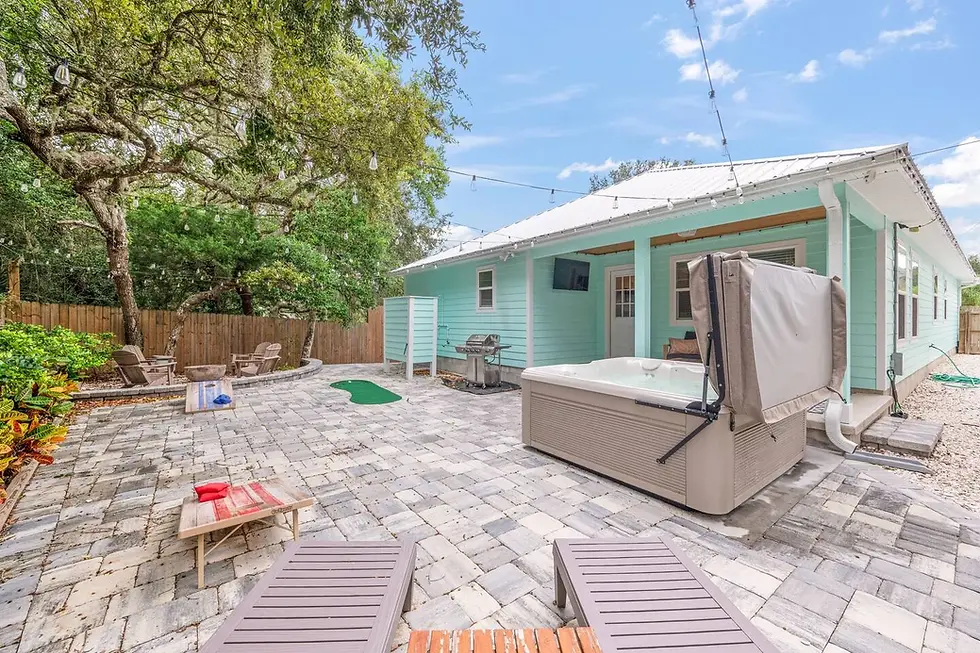
Vilano Beach properties attract families and couples seeking quieter, surf-town beach access without the foot traffic of the Historic District. The Salty Air Retreat and Vilano Vista, both managed by In The Sun VR, sit in this zone and consistently draw guests who prioritize outdoor space, water access, and resort-style backyard amenities. These guests book longer stays, leave higher reviews for outdoor features like heated pools and fire pits, and tend to book further in advance during summer peak season.
The Historic District produces a completely different booking pattern. Properties within walking distance of St. George Street, like the Victorian Villa and the Restored Historic Church in the In The Sun VR portfolio, attract groups who want to walk to the Castillo de San Marcos National Monument, browse the Lightner Museum, and cover the city's history on foot. Demand in this zone spikes hard around the Nights of Lights season (typically November through January) and during spring break, but shoulder-season occupancy requires more aggressive pricing strategy to maintain.
Crescent Beach and St. Augustine Beach properties offer the most direct ocean access, which is the single highest-demand amenity in the market according to consistent guest review analysis. Point Break, which sits 0.1 miles from Crescent Beach access, demonstrates how proximity to a specific beach entry point can anchor a property's positioning and justify premium rates independent of the property's size. Fort Matanzas National Monument is 4.2 miles from that same location, and families who care about both beach access and history book that combination specifically.
The practical implication: your management company's pricing strategy, listing photography, and guest communication approach should all reflect which micromarket your property occupies. A management company that applies the same template to a Vilano Beach surf house and a Historic District villa is leaving revenue on the table for both properties. You should ask any prospective management company how they handle this distinction, and if they cannot give you a specific answer, that tells you everything.

What Are the Real Costs of St. Augustine Vacation Rental Management?
St. Augustine vacation rental management fees typically range from 15% to 25% of gross revenue, but the percentage alone does not tell you what you will actually pay. The hidden costs that owners discover after signing a contract often shift the effective rate significantly higher, and this is the area where most management company comparisons fall apart because no one is comparing apples to apples.
The Fee Breakdown Most Companies Do Not Advertise
Owner bill-backs are the most common surprise. Some management companies charge owners separately for consumable restocking (toilet paper, soap, coffee), minor maintenance labor, credit card processing on owner disbursements, and platform fee adjustments. Coastal Realty publishes a clearly differentiated policy: no owner bill-backs, cleaners keep 100% of cleaning fees, and owners only pay material costs for maintenance, not labor. That is a specific, owner-friendly structure that reduces ambiguity. Not every company operates this way, and most do not state their policy as clearly.
Maintenance markups are another cost that rarely appears in the initial fee discussion. When a management company coordinates a plumber or HVAC technician, some charge owners a markup above the vendor's invoice, typically ranging from 10% to 20% of the repair cost. Ask directly whether the company charges a coordination markup on third-party maintenance, and get the answer in writing before signing.
Credit card processing fees on owner disbursements are a smaller but real cost. Coastal Realty's policy of offering direct deposit at no additional cost is worth noting because some operators charge a processing fee on each owner payment. These fees compound across 12 monthly disbursements.
What the Percentage Fee Actually Buys You
A 20% management fee on a property averaging $35,500 in annual revenue (the St. Augustine market average per AirDNA) equals $7,100 per year. That should buy you active dynamic pricing, multi-platform listing distribution, professional photography, 24/7 guest support, cleaning coordination, and maintenance oversight. If any of those elements are absent or partially covered, you are overpaying for the service level you receive.
The comparison that matters most is not fee percentage versus fee percentage. It is net revenue after all costs, including management fees, bill-backs, maintenance, and platform fees. A company charging 18% with frequent bill-backs may cost more than a company charging 22% with a clean, all-inclusive structure. Run the full-cost comparison, not just the headline rate.
Cost Category | Boutique Local Manager | National Platform | Self-Management |
Management Fee | 15-25% of gross revenue | 15-25% of gross revenue | 0% (your time instead) |
Owner Bill-Backs | Varies by company; some charge none | Often included in base fee | Direct cost to you |
Maintenance Markup | 0-20% on vendor invoices (varies) | Often standardized in contract | No markup, but full coordination burden |
Dynamic Pricing Tools | Included at most reputable operators | Proprietary tools (e.g., AvantStay's Lighthouse) | PriceLabs or Wheelhouse at $20-50/month |
Listing Distribution | Airbnb, VRBO, direct booking (typical) | 50+ channels (AvantStay); 30+ (Grand Welcome) | Airbnb and VRBO only (typical) |
Local Market Knowledge | High (neighborhood-specific expertise) | Variable (national templates, local staff) | Only what you research yourself |
What Are St. Augustine's Short-Term Rental Regulations in 2026?
St. Augustine short-term rental regulations require property owners to complete a formal application process before accepting any paying guests. As of 2026, operating a short-term rental in St. Augustine without proper licensing exposes you to fines and forced cessation of rental activity, making compliance one of the highest-stakes operational decisions you face as a property owner.
The application process involves three distinct documents. First, you need a Local Business Tax Receipt from either St. Johns County or the City of St. Augustine, depending on whether your property is within city limits. Second, you need a copy of your Florida Department of Revenue Certificate of Sales and Use Tax, because Florida law requires short-term rental marketplaces to register with the Florida Department of Revenue and collect sales and transient taxes on bookings made through their platform. Third, you need a copy of your Florida Department of Business and Professional Regulation license, which governs vacation rental properties statewide.
Short-term rental applications in St. Augustine must be renewed every 12 months. An exemption applies if the dwelling is occupied on a full-time basis and declared as homestead. If you are converting a primary residence into a part-time rental, verify your homestead status before proceeding.
For out-of-state owners, tracking regulatory changes from a distance is genuinely difficult. St. Augustine's regulatory environment received an AirDNA score of 64 out of 100, indicating moderate regulatory friction. That score reflects real ongoing complexity. In The Sun VR's regulatory and compliance service monitors these requirements as an active operational function, not a one-time setup task, which means managed property owners receive notice of relevant changes before they become compliance issues rather than after.
If you prefer to research this directly, the Florida State Parks system and St. Johns County's official government portal are the starting points for zoning verification. For the tax side, the Florida Department of Revenue's short-term rental guidance covers your collection and remittance obligations clearly.
Local Boutique vs. National Platform: Which Is Right for Your Property?
Choosing between a boutique local management company and a national vacation rental platform is the most consequential decision St. Augustine property owners face, and it is a decision that competitors in this market almost never help you make honestly because each type of company has an obvious financial incentive to recommend itself.
What National Platforms Do Well
National companies like AvantStay offer real structural advantages. Listing distribution across 50 or more booking channels is genuinely valuable for maximizing search visibility. Proprietary owner portals like AvantStay's Lighthouse tool provide transparent, real-time reservation and performance tracking. A 7:1 staff-to-home ratio, which AvantStay publishes as a benchmark, reflects meaningful operational infrastructure. AvantStay's reported average revenue lift of 20% over traditional managers, if it holds at the property level, represents a compelling financial case.
The realistic limitation of national platforms in a market like St. Augustine is the local knowledge gap. A company managing 2,500-plus homes across 140 markets, of which nine are in St. Augustine, applies templates built for broad performance, not for the specific dynamics of the Vilano Beach market during Nights of Lights season or the Crescent Beach niche during spring break. Local demand nuances get smoothed out at that scale, which is exactly where boutique operators with concentrated market focus can outperform.
What Local Boutique Management Does Well
Local boutique operators know which local vendors respond reliably at 8pm on a Saturday, which neighborhoods see surges during specific events, and how to photograph a property's outdoor space to maximize click-through rates specifically against the St. Augustine competitive set. Coastal Realty's 30-plus years in this specific market represents a depth of local knowledge that no national company can replicate from a headquarters in another state.
The limitation of boutique operators is capacity and infrastructure. Smaller teams mean fewer distribution channels and, sometimes, more manual processes for pricing and reporting. The quality gap between boutique operators varies more than it does among national platforms that have standardized their processes at scale.
For most owners with a single St. Augustine property seeking genuine hospitality-driven management with local expertise and transparent owner communication, a well-run boutique operator is the stronger choice. For portfolio owners with multiple properties who prioritize scale, standardized reporting, and maximum distribution, a national platform may justify its structure. You can also explore how the best vacation rental management companies in St. Augustine compare in 2026 to evaluate your specific options side by side.
What Questions Should You Ask Before Hiring a St. Augustine Manager?
Evaluating a vacation rental management company in St. Augustine requires asking specific questions that most companies do not volunteer answers to, because the answers sometimes make the deal less attractive. The questions below are the ones that separate management companies that deliver consistent results from those that rely on vague promises and favorable market conditions.
Questions About Fees and Contract Terms
Is the management fee calculated on gross revenue or net revenue? Some companies apply their percentage after deducting platform fees, which changes the effective cost significantly.
What owner bill-backs exist outside the management fee? Ask for a complete list, including supply restocking, maintenance coordination markup, credit card processing, and photography refresh fees.
What is the contract termination clause? Know the notice period required, whether there is a penalty for early termination, and whether bookings made during the contract period persist after you leave.
How are owner disbursements handled? Ask for the payment schedule, the method (direct deposit versus check), and whether any processing fees apply.
Questions About Operations and Local Expertise
How does your pricing strategy account for St. Augustine's seasonal demand peaks? A credible answer references Nights of Lights, spring break, summer beach season, and fall festivals specifically, with a description of when rate adjustments begin before each peak.
Who handles after-hours guest emergencies, and what is the response time standard? Ask whether the emergency contact is an internal team member or a third-party call center. The difference matters at 2am.
How many properties does your team currently manage in St. Augustine? A team managing 80 properties with four staff members has a very different capacity than a team managing 20 with six.
What is your average review score across managed properties, and can you share recent guest reviews? A company confident in its guest management performance will share this without hesitation.
If a management company resists answering any of these questions clearly, that resistance is the answer. You can find a broader framework for evaluating whether professional management is the right investment at all in this guide on whether property management is worth it for St. Augustine owners.

How Does Seasonal Demand Shape Management Strategy in St. Augustine?
St. Augustine's short-term rental market operates across four distinct seasonal demand phases, and a management company that does not actively adjust strategy for each phase is leaving a significant portion of your annual revenue uncaptured. According to AirDNA market data, St. Augustine's Seasonality score is 70 out of 100, reflecting moderate but meaningful fluctuation that requires active management rather than passive rate-holding.
Summer beach season (June through August) is the highest-demand period across all St. Augustine neighborhoods. Properties with direct beach proximity, private pools, or water access amenities command the widest rate premiums during this window. Families book three to four months in advance for peak summer weeks, and properties that are not positioned with competitive rates by February regularly lose high-value summer bookings to listings that moved earlier.
Nights of Lights (typically November through January) is St. Augustine's signature event season and the demand surge that separates management companies that know this market from those that do not. Historic District properties see the sharpest revenue spikes during this period, but even beach-area properties benefit from increased regional visitation. Rate adjustments for Nights of Lights should begin in September. A management company that waits until October to address holiday pricing is already behind.
Spring break (typically March through early April) drives a different guest profile: larger groups, higher noise tolerance, and a preference for properties with extensive outdoor entertaining space. Properties like the Vilano Beach four-bedroom with an outdoor summer kitchen and backyard putt-putt perform particularly well during this window because the amenity set matches what group travelers prioritize.
Shoulder seasons (September to October and late January to February) require the most active pricing discipline. Occupancy rate drops are predictable, but ADR does not have to drop proportionally. A management company with a clear shoulder-season strategy, including targeted promotions, longer minimum stays at discounted rates, and mid-term rental flexibility, can maintain meaningful revenue during periods when competitors see significant booking gaps. The 59% of St. Augustine listings available 271 to 365 nights per year reflects owners who have committed to year-round operation, and the ones who perform best are the ones with a genuine strategy for every part of the calendar.
You can explore the specific best times to maximize vacation rental income in St. Augustine in more detail through this seasonal income guide, which breaks down demand patterns month by month.
Frequently Asked Questions About St. Augustine Vacation Rental Management
How much does vacation rental management cost in St. Augustine, FL?
St. Augustine vacation rental management fees typically range from 15% to 25% of gross rental revenue, depending on whether you are working with a full-service operator or a more limited management offering. Full-service operators at the higher end of that range typically include dynamic pricing, multi-platform listing distribution, guest communication, cleaning coordination, and maintenance oversight. The effective cost can be higher once owner bill-backs for supplies, maintenance markups, and credit card processing fees are added. Always ask for a complete cost breakdown, not just the headline percentage, before signing any management agreement.
Do I need a permit to operate a short-term rental in St. Augustine?
Yes. Short-term rental operators in St. Augustine are required to submit a Short-Term Rental Application to St. Johns County or the City of St. Augustine, depending on the property's location. The required documents include a Local Business Tax Receipt, a Florida Department of Revenue Certificate of Sales and Use Tax, and a Florida Department of Business and Professional Regulation license. Applications must be renewed annually. An exemption applies to homestead-declared primary residences, but that exemption covers very few investment properties. Operating without proper licensing exposes owners to fines and potential forced cessation of rental activity.
What is the average revenue for a St. Augustine vacation rental?
According to AirDNA market data, the average annual revenue for a St. Augustine short-term rental property is $35,500, with an average daily rate of $285.80 and an occupancy rate of 56%. Revenue per available rental (RevPAR) reached $157.50, up 6% year over year. These are market averages across 6,865 total listings tracked on Airbnb and Vrbo. Properties with differentiated amenities, professional photography, active dynamic pricing, and strong review velocity consistently outperform these averages. Properties that self-manage with static pricing or rely on a single platform typically underperform them.
What is the difference between boutique local management and a national company in St. Augustine?
St. Augustine boutique management companies offer concentrated local market knowledge, neighborhood-specific pricing strategies, and direct access to the local vendor network, which matters significantly when a maintenance issue arises on a weekend. National platforms like AvantStay offer broader listing distribution (50-plus channels), proprietary owner portals, and standardized processes built for scale. The trade-off is local depth versus infrastructure scale. For most single-property St. Augustine owners, a well-run local operator with active dynamic pricing and genuine hospitality standards outperforms a national template. For multi-property portfolio owners prioritizing reporting and distribution breadth, national platforms offer real structural advantages.
How does dynamic pricing work for St. Augustine vacation rentals?
Dynamic pricing for St. Augustine vacation rentals refers to automated, demand-responsive rate adjustments that increase nightly rates during high-demand periods (Nights of Lights, summer beach season, spring break) and reduce them strategically during shoulder seasons to maintain occupancy. Professional management companies use pricing tools calibrated with local demand data, historical booking patterns, and competitor rate tracking. Static pricing set once at onboarding is one of the most common and costly mistakes St. Augustine property owners make. A management company that cannot explain how and when it adjusts your rates is almost certainly leaving money on the table during the market's four distinct seasonal peaks.
Which St. Augustine neighborhoods earn the most from short-term rentals?
Revenue potential in St. Augustine's STR market varies significantly by neighborhood. Vilano Beach properties attract families and couples seeking quieter beach access with outdoor amenity focus, commanding strong summer rates. Historic District properties near St. George Street perform best during Nights of Lights and spring cultural events, with guests prioritizing walkability to attractions like the Castillo de San Marcos National Monument and the Lightner Museum. Crescent Beach and St. Augustine Beach properties with direct ocean access command the broadest year-round demand due to beach proximity. The right neighborhood for investment depends on the property type, target guest profile, and seasonal demand pattern you want to optimize around.
What amenities drive the best reviews and rates in St. Augustine vacation rentals?
In St. Augustine's short-term rental market, outdoor entertaining amenities consistently appear in top-rated guest reviews and justify above-market nightly rates. Private pools, hot tubs, fire pits, outdoor kitchens, and direct beach or water access are the highest-impact amenity investments based on both booking data and review content. Indoor standout features like golf simulators, game rooms, and dedicated workspaces extend appeal to specific guest segments (golf travelers, remote workers, families) and widen the booking window beyond peak summer season. The Vilano Vista property's seven-seater hot tub and dual fire pits, for example, generate consistent review mentions that support premium seasonal pricing.
What Should St. Augustine Property Owners Do Next?
The difference between a St. Augustine vacation rental that earns its full potential and one that plateaus at average performance rarely comes down to location or property size. It comes down to the pricing intelligence, the guest management systems, the cleanliness standards, and the local expertise of the team running it. In 2026, with active STR listings in the market growing 8% year over year and competition for top-ranked search placement intensifying on both Airbnb and VRBO, the gap between professionally managed properties and self-managed or poorly managed ones is only widening.
For out-of-state owners, the operational burden of managing from a distance is compounded by every regulatory update, every maintenance call, and every guest message that arrives at midnight. For burned-out self-managing owners, the revenue upside of professional management usually more than offsets the management fee once dynamic pricing, multi-platform distribution, and consistent five-star turnover standards are in place. For first-time hosts, building the right foundation from the start prevents the expensive corrections that most owners make in year one.
Review your current management arrangement honestly against the framework in this article. If your management company cannot explain its seasonal pricing strategy for Nights of Lights, does not provide clear owner disbursement terms, or has never raised the question of your compliance documentation with St. Johns County, those are actionable gaps worth addressing now, not at your next contract renewal.
For deeper reading on the full landscape of management options in this market, the ultimate guide to short-term rental management in St. Augustine covers the operational picture from initial setup through ongoing optimization.

If you are ready to see what your St. Augustine property is genuinely capable of under management built around hospitality standards, local market depth, and transparent owner communication, the team at In The Sun VR is currently accepting new managed properties. We handle listing optimization, dynamic pricing, guest communication, turnover operations, and regulatory compliance across a portfolio that spans every major St. Augustine neighborhood. Start the conversation at inthesunvr.com and find out what your rental could realistically earn with the right team behind it.


Comments